Turnkey Tier 3 — The Collector
A singular home built around commissioned work, carefully selected art, and pieces with provenance. One or two projects a year.
- Next step
- Request a private visit
- Timeline
- Custom schedule defined per project
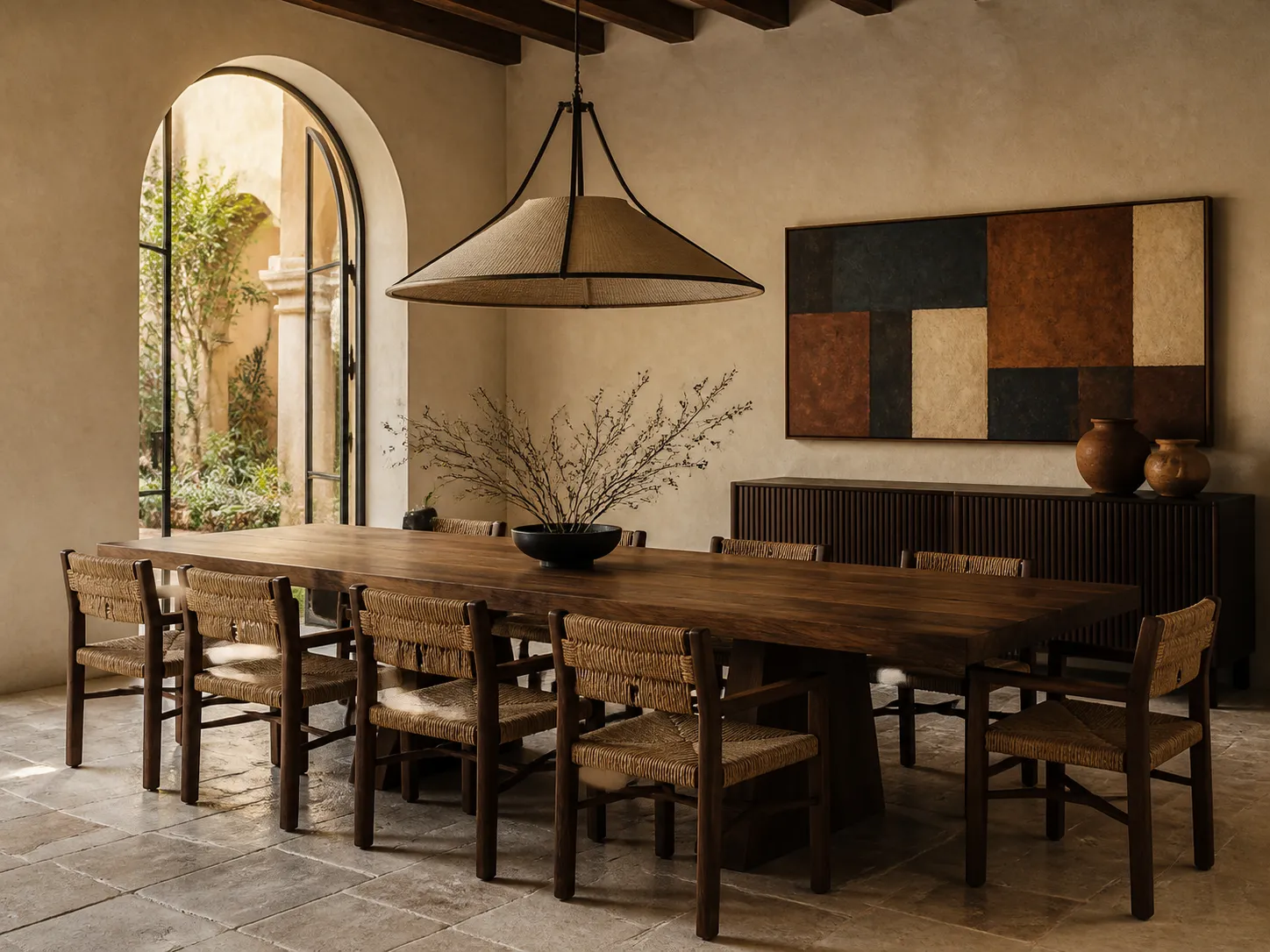
Some houses are furnished. A few are collected. Tier 3 exists for the second kind — homes where the dining table has a maker with a name, the textile on the wall took a season at the loom, and a bound portfolio on the shelf records what every significant piece is, who made it, and why it is here.
We take one or two of these projects a year. This page explains what they are, how they run, and whether yours is one of them.
What is a Collector project?
Everything Tier 2 delivers — full design, procurement, installation, styling, reveal — with the sourcing rebuilt around singularity. The significant pieces in a Collector home are not specified from catalogues. They are commissioned: a dining table from a master carpenter, textiles woven to your rooms’ dimensions, forged iron, hand-thrown ceramic lighting. Or they are found: original Mexican art, antiques, objects with provenance, each documented.
Mexico makes this possible in a way almost nowhere else does. The living craft traditions of Oaxaca, Guanajuato, Guadalajara, and Mexico City still operate at the highest level — masters with waiting lists, studios where the work rivals anything in a gallery. What they mostly lack is a bridge to clients who cannot conduct a commission in Spanish across a complex custom schedule. We are that bridge.
How does the process work?
Private consultation and scoping. A vision session and a property study, from which we build a custom proposal. This conversation is longer and stranger than a furniture briefing — it is about what you love, what you collect already, what you want to live among.
Concept and curation plan. The full design concept, plus the document that defines Tier 3: a sourcing map declaring, piece by piece, what will be commissioned, what will be found, and what will be sourced conventionally. Not everything in a Collector home is a commission — restraint is what lets the significant pieces breathe.
Sourcing trips and commissions. Studio visits and workshops as the project requires. You may join any trip. Commissions are negotiated, briefed, and contracted by us, in Spanish, with makers we have worked with before.
Production oversight. Significant pieces follow the maker’s process, and we manage every commission through completion with photo documentation, so you watch your table exist from rough lumber to final oil.
Installation, styling, and reveal. As Tier 2, at higher stakes: art placement, object arrangement, the styling of a home that is also a collection.
The portfolio. After reveal, the bound home portfolio: every significant piece photographed, its maker named, its story told. Part provenance record, part biography of the house.
Why does provenance matter in a home?
Because it changes your relationship to the objects. A sofa from a showroom is a purchase; a table you watched being built by a man whose father taught him the joinery is a relationship. Homes furnished this way age differently — pieces get repaired instead of replaced, inherited instead of sold.
There is also a practical dimension: documented, commissioned, original work holds value in a way production furniture never does. The portfolio is the paper trail — for insurance, for estates, for the eventual sale of a house that is worth more furnished than empty. But the honest reason clients choose Tier 3 is not resale math. It is walking into a room where every object belongs to a story you know.
Why is every Collector project proposed privately?
Commission-heavy projects vary enormously: how many rooms carry significant work, whether the art program is emerging artists or established names, and how far the antique hunt goes. Honest scoping requires a private conversation and a property study.
The custom proposal puts the full scope in writing before anything is signed, with schedules for major commissioned pieces stated individually.
Is Tier 3 the right tier for you?
Signals that it is: you already collect something — art, ceramics, books, anything — and understand the difference between owning and choosing. You care who made a thing. You understand that commissioned work follows a schedule shaped by craft, scale, and complexity. You want the house that guests stop in, mid-sentence.
Signals it is not: you need the house finished for a fixed deadline that does not allow for custom commissions. Your budget centers below the floor — Tier 2 spent well beats Tier 3 spent thin, every time. Or the property is an income asset, where Tier 1’s discipline is the smarter money.
If your renovation is still underway, Project Shepherding can run the construction phase while the curation plan develops — commissions started during a build finish on time for the install.
How do you begin?
The same property visit every project starts with — two hours at the property, a direction memo after. If the conversation reveals a Collector project, we move to the private scoping session. If it reveals a Tier 2 project, we will say so plainly.
One or two a year. If this is your year, we should talk.